
Chili Inputs for Removable Simmering Spice Bags
For a removable simmering spice bag, start with whole dried pods where volume allows and compare cut pieces when loading needs a smaller form. Choose the full mixture, including loose seeds and fines, against the actual bag. Send the cooking medium, fabric and closure details and escaped-particle examples. We can discuss the chili preparation while your wet-use trial tests the ingredient-and-bag pair through simmering and removal.
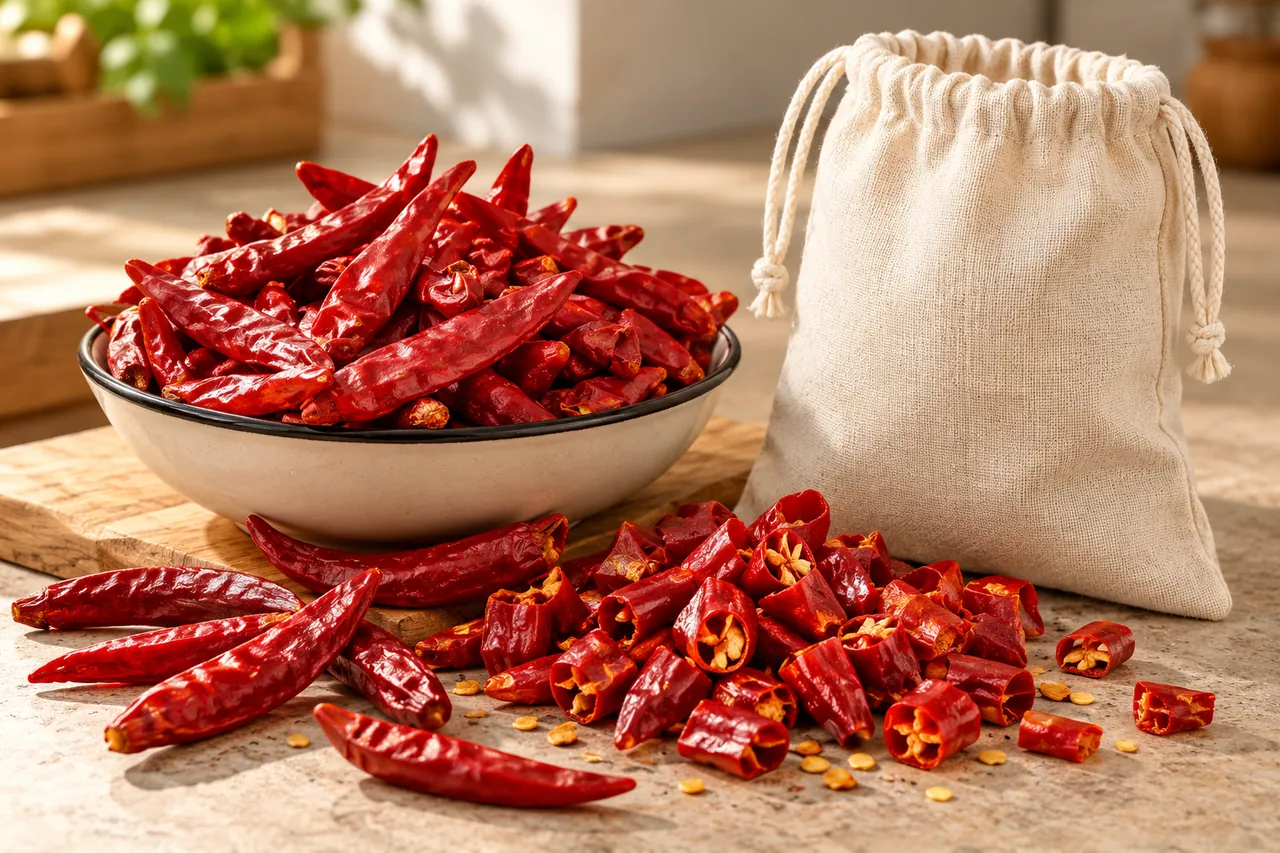
- Whole-pod start
- Whole pods can be compared where bag volume allows, but accompanying small fractions still matter.
- Cut alternative
- Cut-pod pieces list 8,000–12,000 SHU and 8–12% moisture; actual cut dimensions need definition.
- Wet retention task
- Test fabric, seams, closure and loading during simmering and lifting, not only with a dry sieve.
Prepare the chili mixture for the bag comparison
Define main pieces, seeds and fines separately from bag construction and food-contact evidence.
- 01During simmering
Set the actual medium, loading and agitation route.
- 02During lifting
Keep the real closure, removal and draining method in the comparison.
- 03At service
Inspect outside solids separately from the desired liquid flavour.
RELIA SPICES cleans and destems purchased dried chilies before the agreed cutting or reduction, sieving and packing. Specify main pieces, loose seeds, fragments and fines together. We can discuss that supplied preparation; the bag, seam and closure require their own specification.
Moisture and particle checks are internal; ASTA, SHU and microbiology use external laboratories. In-house steam microbial reduction is selected according to order requirements. Neither the selected treatment nor a dry sieve result establishes wet retention or the bag's food-contact suitability.
Compare whole pods, cut pieces and rings
Whole pods, pieces and rings differ in form and heat, not in a proven leakage ranking.
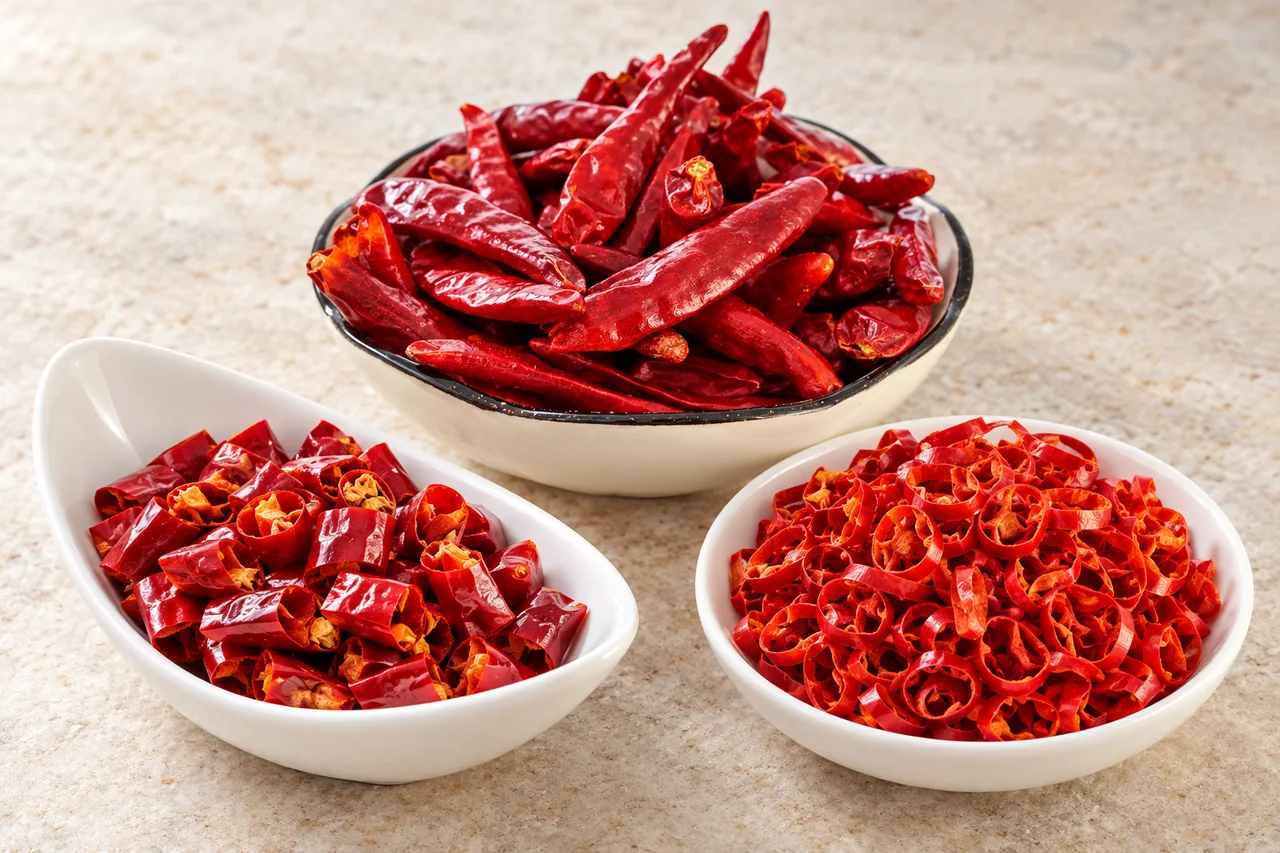
The whole red chili candidate presents intact red wrinkled pods, with AD as a written descriptor and an instruction not to eat directly. The cut-pod candidate shows rings or segments with seeds, gives 8–12% moisture and an 8,000–12,000 SHU reference, and needs the actual cut dimensions established. Tianying ring R5002 gives 15,000–20,000 SHU and a 1 mm reference with an unresolved measured axis. Those differences do not rank extraction or leakage. Choose a defined preparation whose main pieces and smaller fractions can be compared with the bag actually used.
Ingredients to compare for this application
Whole dried pods for a larger bag input
A first form comparison where the assessed bag has usable volume for intact pods.
- Intact red, wrinkled whole-pod presentation.
- AD descriptor and instruction not to eat directly.
- 24-month cooler-storage reference does not establish an ambient condition.
Cut-pod pieces for a smaller-form comparison
Compare the actual segments and accompanying seeds where whole pods do not suit loading.
- Pictures show rings or segments with seeds.
- 8–12% moisture and 8,000–12,000 SHU references.
- The 4–7 cm entry does not establish supplied-cut dimensions.
Tianying rings for a separately defined mixture
A ring-form alternative to test with the same bag construction and wet-use route.
- 15,000–20,000 SHU reference.
- 1 mm graininess needs a defined measured axis and material basis.
- Steam-treatment reference requires actual execution and applicability.
These product specifications are a starting point for selecting a grade. Match the proposed material and sample to your food and order requirements.
Match the whole mixture to the wet retention task
Separate escaped solids from red liquid before changing the supplied fraction.
| Interface | Define or observe | Decision |
|---|---|---|
| Dry chili | Main pieces, seeds, fragments and fines | Choose the supplied mixture |
| Bag construction | Fabric, seams, closure and applicable food-use evidence | Qualify the bag separately |
| Simmering and removal | Actual loading, agitation and outside solids | Locate the retention failure |
| Broth endpoint | Colour, flavour and heat separate from solids | Retain the desired result without a no-leak claim |
Large pods may carry loose seeds and fragments; cutting and handling can add fines. The material that escapes may therefore differ from the main pieces seen in a bowl. Inspect the complete incoming mixture and its condition after handling.
Our internal particle and moisture checks describe that dry preparation. The cut-pod candidate lists 8–12% moisture and 8,000–12,000 SHU, but its 4–7 cm entry does not define supplied cuts. Compare the chosen fraction with the actual fabric, seams, closure and loading during simmering, stirring and lifting. Identify solids outside the bag separately from red colour and flavour in the liquid. This directs a change in material or bag construction without treating SHU as extraction evidence or promising no leakage.
Describe fabric openings, seams and usable volume
Bag evidence must match the actual food and heating conditions, not a fabric name alone.
- ✓Fabric or retention basis
Obtain the actual construction and criterion; a material name alone does not approve use.
- ✓Seams and closure
Include the real lifting and removal route in the comparison.
- ✓Food contact
Match supporting evidence to the actual aqueous or fatty food and heating conditions.
Obtain the bag’s actual fabric or retention specification, seam construction, closure and usable volume from its responsible source. FDA’s food-contact framework distinguishes food types and conditions of use, including aqueous or fatty foods and heating. It does not approve a particular bag through its material name. Request evidence applicable to the real cooking medium and contact route. Fit the chili loading to the bag that is actually assessed; changing fabric, seams or closure is a separate design change, not proof that the pepper preparation itself has become more retentive.
Follow hydration, agitation and removal together
Lifting and draining can expose a failure absent during steady simmering.
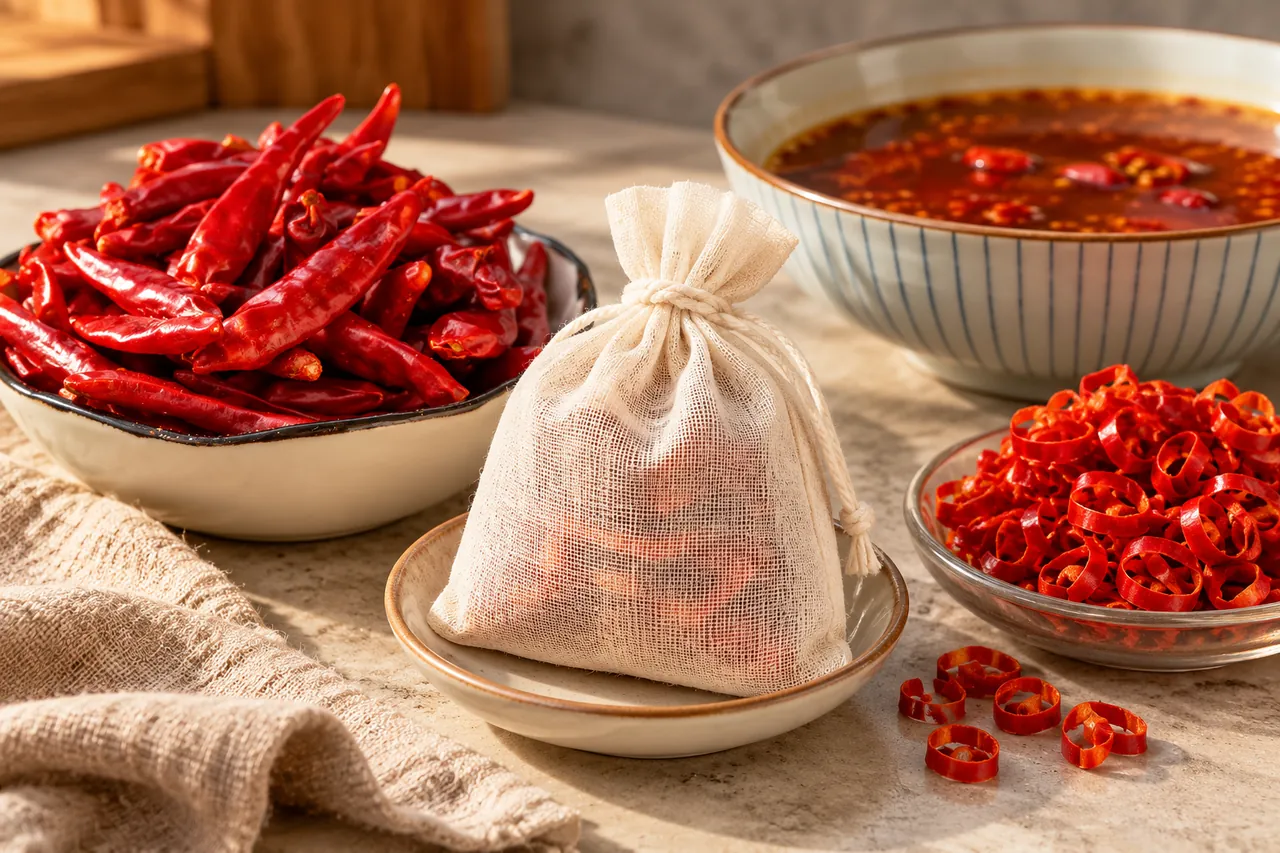
Compare the filled bag through the normal simmering, stirring and lifting sequence. Inspect outside solids during cooking and immediately after removal; lifting can expose a different failure from steady simmering. Keep the loading basis, closure and handling unchanged during the first ingredient comparison. Observe expansion, fragmentation and seed release without assigning the cause in advance. A dry sieve description can identify the input fraction but cannot demonstrate the behaviour of wet pieces, a stressed seam or a closure under your actual lifting route.
Measure escaped solids separately from colour and heat
Ingredient SHU describes neither broth extraction nor the proportion of solids retained.
- 01Solid-retention result
Inspect actual particles outside the bag under an agreed sampling method.
- 02Flavour result
Assess colour, pepper character and heat separately; ingredient SHU does not predict broth extraction.
Separate escaped solid particles from the colour and flavour appearing in the liquid. A red liquid alone does not identify a solid-retention failure. Inspect representative liquid samples for particles using an agreed method and compare flavour and heat as a separate endpoint. The 8,000–12,000 SHU cut-pod reference and 15,000–20,000 SHU ring reference describe ingredients, not broth extraction or a retention percentage. If flavour is adequate but visible solids fail, investigate the relevant fraction and bag interface rather than automatically increasing the main piece size.
Approve ingredient treatment and bag evidence separately
Ingredient microbial treatment and bag food-contact qualification answer different questions.
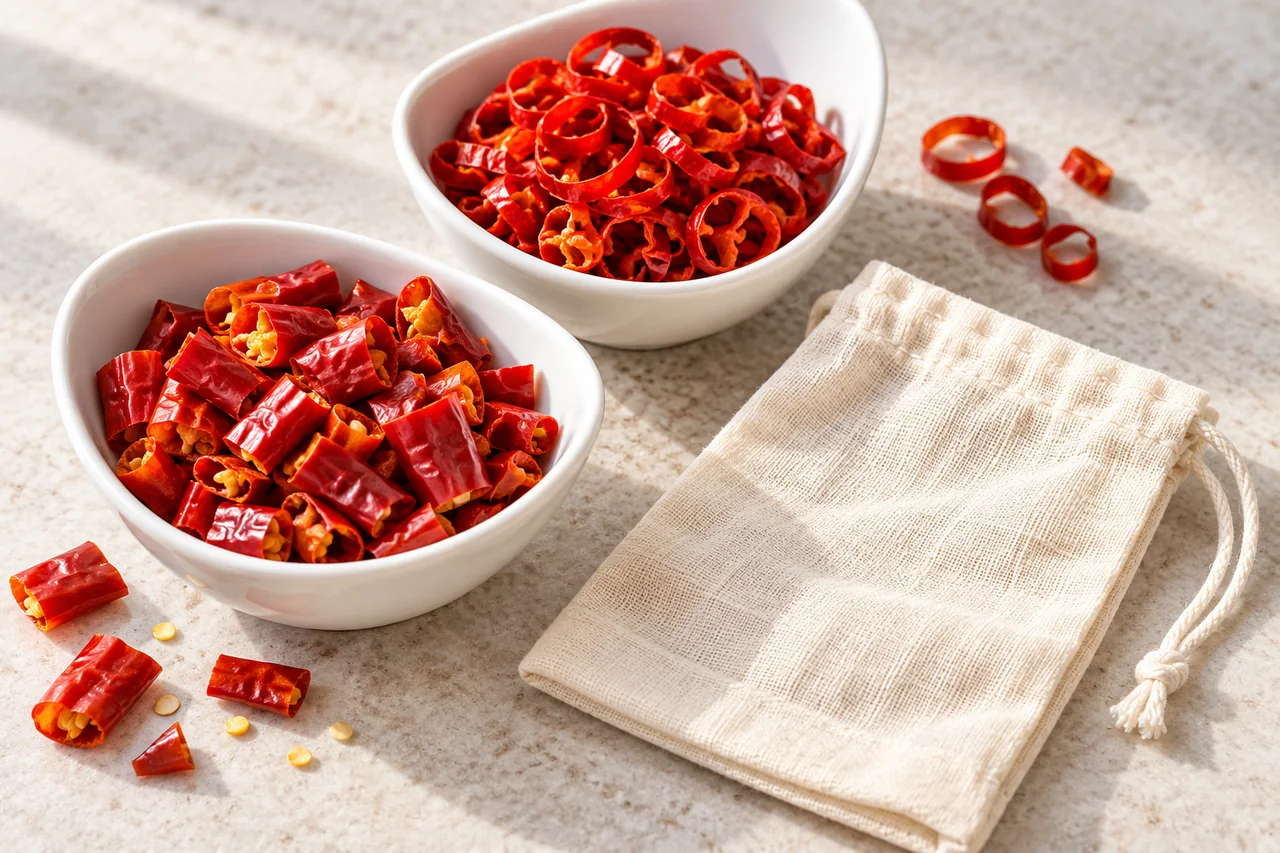
RELIA SPICES has in-house steam microbial-reduction equipment used according to order requirements. Select the actual ingredient process and relevant external microbiological evidence separately from the bag's food-contact assessment. The whole-pod instruction not to eat directly remains applicable; a ring steam reference still needs execution for the supplied material. Our internal particle and moisture checks do not establish chemical migration compliance or retention when wet. Likewise, a successful bag trial cannot establish microbiological safety or finished-food shelf life. Those decisions require the applicable material, process and food-use evidence.
Compare offers for a matched material brief
Compare the same loading and cooking endpoint, including later straining where actually used.
- 01Chili preparation
Define main pieces, seeds, fragments and fines in the supplied material.
- 02Bag interface
Keep fabric, seams, closure and loading unchanged during the first material comparison.
- 03Actual endpoint
Include simmering, lifting and any later straining when judging the usable result.
Compare offers for the same loading and food endpoint. Whole pods may require different usable bag volume from cuts, while a preparation with fewer unwanted small fractions still needs actual evidence. Include the preparation work your operation performs and any subsequent straining within the cost comparison. Keep bag manufacturing, filling and assembly outside the chili offer unless an actual supported proposal includes them. An undefined fabric or unknown particle fraction is a reason to clarify the interface; neither can be replaced by a guarantee that a large pepper never leaks.
Send the cooking and bag interface
Send the particle-and-bag interface rather than request an undefined no-leak chili.
- 01Describe cooking
Identify the medium, agitation, loading and removal route.
- 02Show the interface
Provide bag construction and photographs of escaped solids.
- 03Discuss the ingredient
Request an actual whole-pod, cut-pod or ring preparation without a no-leak promise.
Share the cooking medium, fabric and closure, loading and lifting route. Link the whole-pod, cut-pod or ring candidate and show the bag and escaped solids. State the accepted broth flavour separately from the particle limit. We can discuss the chili fraction and selected treatment around that comparison, then agree sample and package scope for the identified material.
- Cooking medium and flavour endpoint
- Actual bag fabric, seams and volume
- Whole-pod or cut preparation
- Seeds, fragments and fines criteria
- Loading, agitation and removal route
- Ingredient and bag documents, quantity and responsibility
Your next purchasing decision
Define the chili-and-bag comparison you will run
Discuss a defined chili preparation for the bag comparison you will run.
Send the bag construction, cooking medium and escaped-particle examples to Qingdao Relia Spices Co., Ltd. / RELIA SPICES. Identify whole pods, pieces or rings and describe the loading and removal route.
The enquiry page keeps this guide with your message. Add your quantity and destination so we can discuss the relevant material.