
Sourcing Chili Flakes with a Defined Cut and Fines Criterion
Choose chili flakes for the visible pieces your food should retain, then set a separate limit for unwanted fine material. Start with Gochugaru, seeded flakes or crushed chili according to the cut and food use you need. Inspect the sample before and after normal transfer or cooking. Send the desired appearance, measurement basis and fine-fraction definition so we can discuss one practical grade.
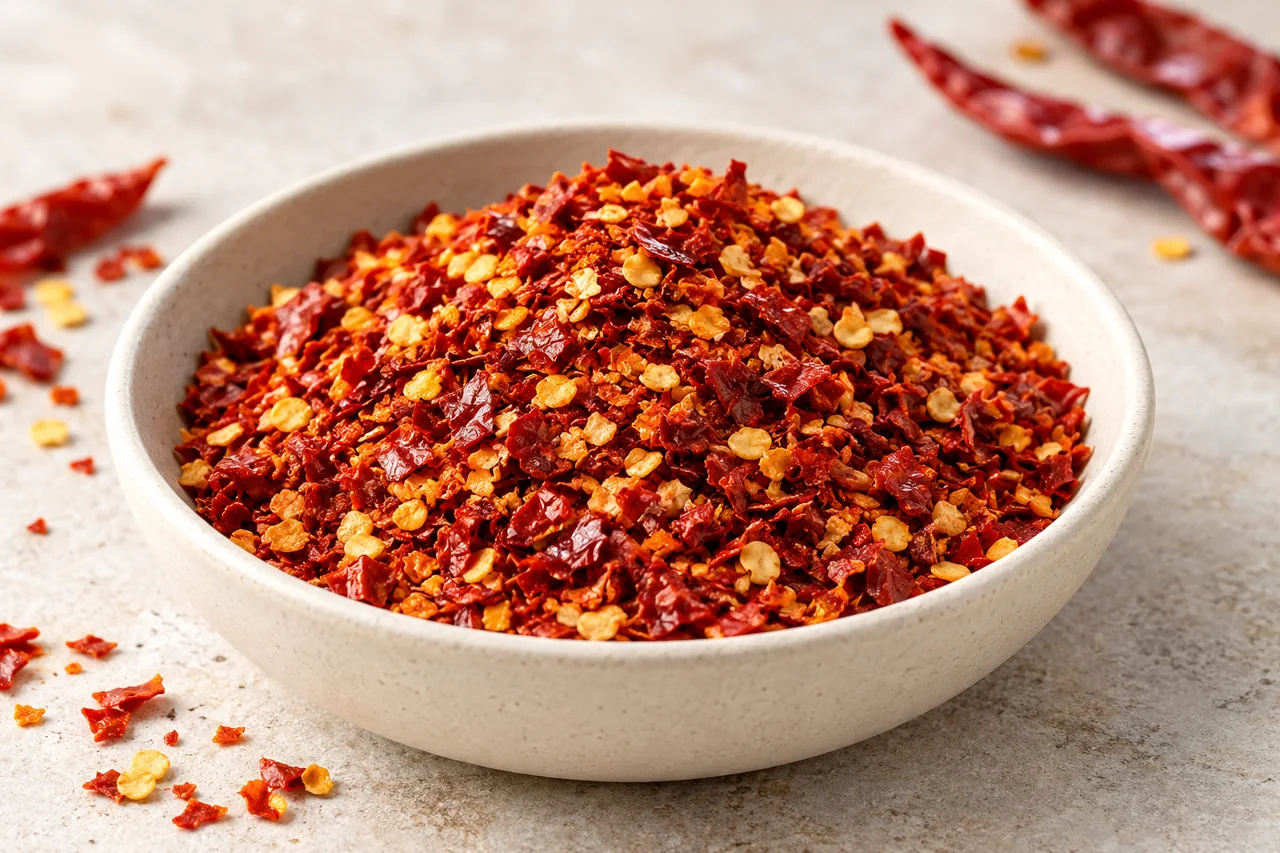
- Main cut
- Define the visible preparation and the dimension, axis or sieve basis used to assess it.
- Fine fraction
- Classify fines separately from whole seeds, broken seeds and impurities.
- Handling result
- Judge the cut reaching the food, not only the attractive incoming sample.
Separate the Main Cut from the Fine Fraction
The main cut, fine fraction and seed condition need separate definitions.
- 01Visible form
Define flakes, crushed pieces or another actual preparation.
- 02Main cut
Name the dimension, axis or sieve basis used to assess that form.
- 03Fine fraction
Define its classification and accepted proportion separately.
RELIA SPICES cuts or crushes dried chili and sieves the preparation in-house, with routine particle and moisture checks internally. Define the pieces your food needs instead of expecting the word coarse to control every fragment.
Start with Gochugaru's 5–8 mesh reference, the seeded-flake route or the separate crushed material. Keep their cut, seeds and heat references independent. Relevant SHU and microbiological analyses go to laboratories for the selected material and order requirements.
Start with the Coarse Gochugaru Reference
Gochugaru's impurity limit is not a limit for small chili fragments.
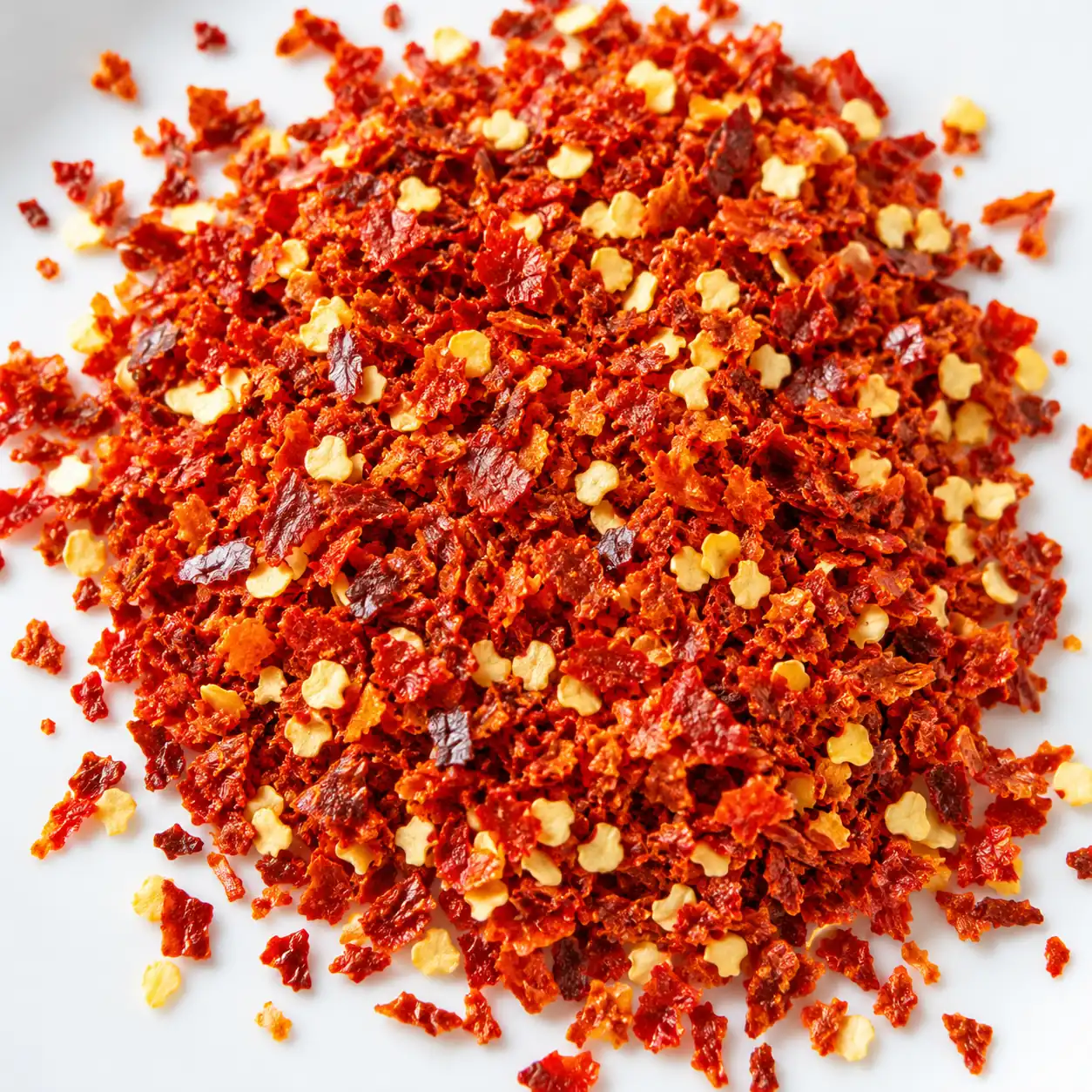
The Gochugaru crushed-flake listing carries a 5–8 mesh reference and describes coarse red flakes with pale seed-like pieces. It also declares moisture ≤8% and impurity ≤0.3%. These are concrete starting details for a hotpot-dipping or kimchi ingredient discussion.
Keep the impurity limit out of the fines calculation. Small chili fragments can be part of the ingredient, while an impurity criterion concerns a different classification. The actual selected material needs a defined particle result rather than an assumption that the mesh reference supplies every cut and fines requirement.
Ingredients to compare for this application
Coarse Gochugaru flakes
Start with a sieve-referenced coarse preparation for kimchi or hotpot dipping.
- 5–8 mesh reference.
- Moisture ≤8%; impurity ≤0.3%.
- Coarse irregular red flakes with visible pale seed-like pieces.
Coarse seeded red flakes
Evaluate when visible seeds and the actual selected cut are important to the food.
- Dried flakes with seeds.
- 7,000–10,000 SHU reference.
- Independent 1–4 mm and 5×7 mm entries; actual cut unselected.
Separate crushed-chili preparation
Compare a selected crushed grade when its actual particle criterion fits the food after transfer.
- Independent 1.5 mm and 1.8 mm references; not confirmed supply variants.
- 3,000–5,000 SHU reference.
- Raw and AD are written descriptors.
These product specifications are a starting point for selecting a grade. Match the proposed material and sample to your food and order requirements.
Resolve Seeded-Flake Dimensions Without Combining Them
Independent seeded-flake dimensions do not establish two available cuts or a combined range.
- 01Identify the preparation
Use the actual supplied seeded flakes rather than a merged dimensional label.
- 02Name the criterion
State the axis or sieve result the buyer will assess.
- 03Evaluate the sample
Compare the selected material on that same basis.
The seeded-flake listing provides a 7,000–10,000 SHU reference and describes dried, Raw and AD material. Its independent 1–4 mm and 5×7 mm statements do not establish a single combined size range or two confirmed available cuts. Choose the actual supplied preparation as the object of the comparison.
State whether the size criterion concerns length, width, sieve passage or another defined feature. A photograph can help show the intended form, but the accepted cut requires a shared measurement basis. Use that basis when comparing the proposed sample with your desired appearance.
Keep Crushed-Chili References as Independent Criteria
Compare particle references only after their measurement bases answer the same buying concern.
| Candidate route | Written starting point | Required selection basis |
|---|---|---|
| Coarse Gochugaru | 5–8 mesh | Actual distribution and desired visible form |
| Seeded flakes | Independent dimensional statements | Selected cut and measurement axis |
| Crushed chili | Independent 1.5 mm and 1.8 mm | Actual criterion and supplied preparation |
The crushed-chili candidate separately states 1.5 mm and 1.8 mm and has a 3,000–5,000 SHU reference. Those entries can guide a preparation discussion, but they are not proof of two supplied grades or a uniform particle size. The actual cut and method still determine whether the material suits the food.
Put each candidate alongside its own technical basis. If one is described by sieve distribution and another by a dimension, do not rank their numbers as if they were the same measurement. First establish a criterion that answers the buyer’s actual particle concern.
Define Fines Before Calculating Their Proportion
Define which material counts as fines before calculating a rate.
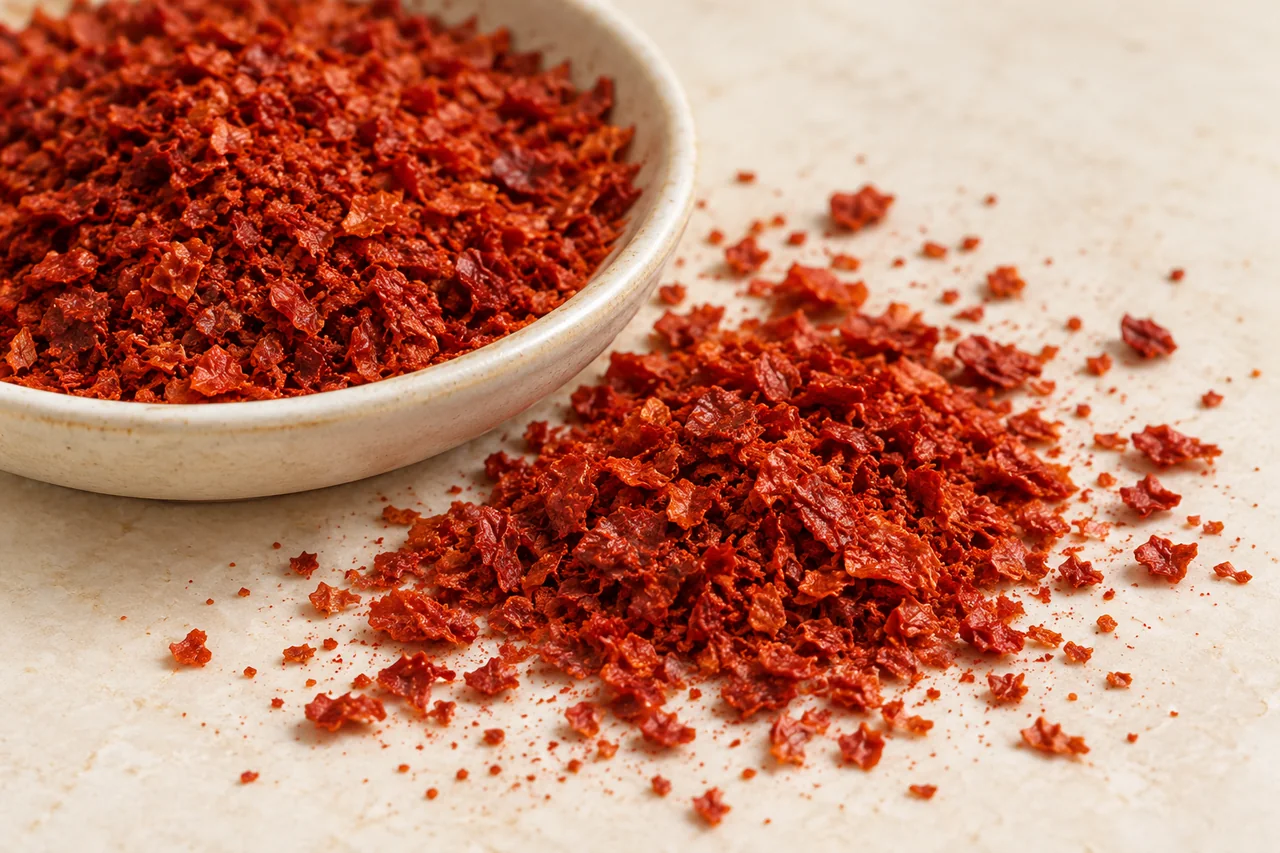
Use the same sample basis and classification for every candidate. If your agreed procedure measures fines by mass, divide that fraction by the starting sample mass. Include the classification in the physical-grade discussion with our internal particle checks.
Decide how whole seeds, broken seeds, skin fragments and extraneous material are treated. Otherwise the buyer and supplier can report different fines rates from essentially the same preparation. Small chili fragments and impurities are not automatically the same category.
Follow the Cut from Crushing to the Food
Check the cut before and after the handling that can create fragments.
- 01Produce the preparation
Cut or crush and sieve the selected dried-chili material.
- 02Assess receipt
Apply the agreed cut and fine-fraction definitions.
- 03Follow normal handling
Repeat the relevant check after the actual transfer or mixing step.
- 04Judge the food
Compare the particles that remain visible or affect texture.
Cutting or crushing creates a population of pepper pieces, not identical shapes. RELIA SPICES performs that preparation and sieving in-house; choose a criterion that describes the actual cut and fine fraction.
Check the incoming material, then repeat the relevant observation after normal transfer, mixing or dosing. Those steps can create smaller fragments or redistribute skin and seeds, so separate a delivered-cut issue from a change during use.
Our routine particle and moisture checks are internal. Agree the classification and sampling basis, then compare the preparation in the intended sauce, dip or seasoning. Select for both the measured cut and the cooked or served result, without assuming zero breakage.
Use the Food to Judge Whether the Difference Matters
A compliant cut still needs acceptable cooked appearance, texture and heat.
- 01Physical fit
The material meets the agreed cut and fine-fraction definition.
- 02Food fit
The same material gives the intended appearance and eating result.
Compare the candidates in the actual sauce, dip or seasoning at the intended use level. Inspect visible pieces and seed appearance after the normal preparation, and assess the flavour and heat independently. A better-looking raw cut may not create the preferred finished-food result.
General particle-size metrology distinguishes techniques and their limitations. Use the agreed measurement to describe the material and the food trial to judge suitability. Do not make a sieve result promise a texture, dispersibility or cooking outcome that has not been evaluated in the application.
Retain a Reference That Shows the Actual Preparation
Retain a representative physical sample of the accepted preparation.
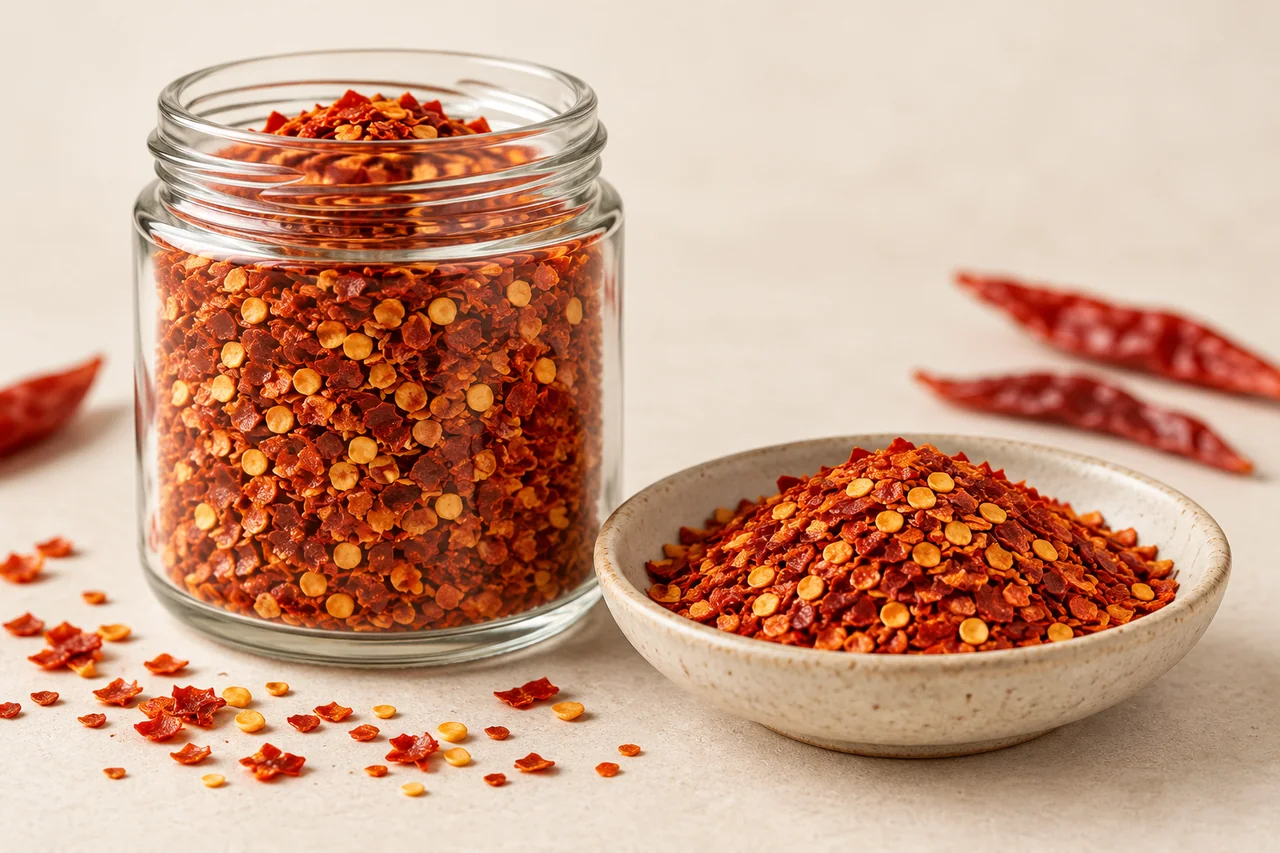
Keep a representative sample of the accepted cut, not only a close-up photograph. Associate it with the heat, composition and handling conditions of the same material. This helps purchasing and production discuss a later change without relying on the vague memory of a coarse red flake.
Use the receiving pack appropriate to the material and your handling route. For the Gochugaru listing, vacuum and woven bag formats are mentioned, but the actual chosen configuration needs its own agreement. Compare a packaging change if it materially changes the particle condition reaching the food.
Request One Measurable Cut-and-Fines Grade
Request one measurable cut-and-fines grade rather than a collection of catalogue dimensions.
- 01Describe
State the visible particle and the food result it must support.
- 02Measure
Use a shared main-cut and fines definition.
- 03Select
Choose the actual preparation that survives the intended handling and food process.
Send the food use, actual form, dimensional or sieve criterion and the fine-material definition. Add seed-composition and heat conditions and identify the handling step where acceptance matters. We can use those inputs to discuss a relevant candidate and its actual preparation.
The useful result is a material specification that your receiving and food teams interpret the same way. It should not be a combined list of every dimension found in several catalogue entries. Keep a powder sieve purchase separate from a visible-flake cut decision.
- Food use and desired form
- Dimensional axes or sieve basis
- Actual cut requirement
- Fines definition and threshold
- Heat and seed-composition limits
- Quantity, pack and sampling needs
Your next purchasing decision
Talk through your flake cut and fines requirement
Send the visible target, fines definition and handling stage where acceptance matters.
Send RELIA SPICES the food, visible cut and definition of fines, including any seed condition. Identify the transfer or cooking stage where the appearance matters.
We can discuss a produced flake or crushed preparation and the internal physical criterion that should accompany the selected material.
The enquiry page keeps this guide with your message. Add your quantity and destination so we can discuss the relevant material.